11/05/2022

My best films ever list (first attempt)


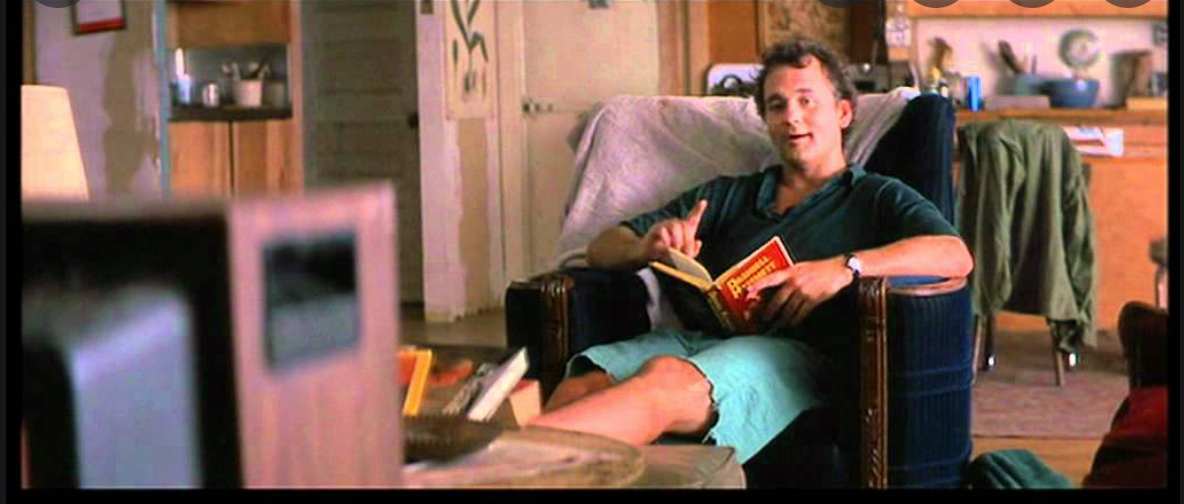
Tootsie: Bill Murray, "That's ... one nutty hospital"

A high-school teacher of philosophy reviled that he runs a film club for his students.  I asked about the titles.  Most, as far as I could identify them, where with a positive moral conclusion, with an outlook helpful in navigating the approaching adulthood.  It made sense since the course was for the students about to graduate.


I said that when I was teaching filmmaking my choices where not that wholesome, rather bordelining on “sick”, and probably not appropriate for the young audiences as a source of “feel good, educational inspiration".  At which point he challenged me to create a list of my films.  Upon completing it I realised that there are two kinds of films there: one says it’s all gloom and doom, along the lines of “Forget it Jake, it’s Chinatown”:  


  1. Irreversible, dir. Caspar Noe
  2. Chinatown, dir. Roman Polański
  3. Nocturnal Animals, dir. Tom Ford   
  4. Biutiful, dir. Alejandro Gonzalez Inarritu   
  5. Requiem for a dream, dir. Darren Aronofsky 
  6. Pulp Fiction, dir. Querten Tarantino
  7. Mullholand Drive, dir. David Lynch
  8. Vertigo, dir. Alfred Hitchcock 
  9. Eyes Wide Shut, dir. Stanley Kubrick
  10. Black Widow, dir Bob Rafelson 
  11. King Ubu, dir. Piotr Szulkin


The second list chimes more with a line from Tootsie “That's... one nutty hospital”: 


1. Adaptation, dir. Spike Jonze

2. Eternal Sunshine of the spotless mind, dir. Michel Gondry

3. Being John Malcovitch, dir. Spike Jonze

4. Tootsie, dir. Sydney Pollack

5. Some like it Hot, dir. Billy Wider


The “doom and gloom” outnumbers “whimsical”.  Hmmmm…..


the lists leave out the masterpieces of Kieślowski, Skolimowski, Tarr, Antonioni, Bergman and the likes.   to be continued...


4/21/2022

A nightmare of a documentary filmmaker.

A nightmare of a documentary filmmaker:   For some reasons I am publicly showing a documentary by a noted Polish feature film director Krzysztof Zanussi.  Mr. Zanussi did make a few docs, but is known for his features and one of them -  “Illumination” floored me when it first came out.  I remember that watching it made me feel that I was hooked into the very center of being, whatever that meant.  I am a bit afraid to re-watch it now.  


Anyway,  the subject of the documentary is not revealed in the dream.   I suspect that it wasn’t even a real film.  It was “something out there”, unspecified.   


The documentary is screened in front of a large audience, in an open space, somewhere in between a cluster of drab, tall post-communist apartment buildings from the 1970-is, the setting still typical in many smaller and bigger cities in Poland.  Think Kieslowski’s “Decalogue” and you will get the picture.  


Somewhere behind a screen, the sun is picturesquely reaching the horizon.   Because of the angles of the buildings it is hard to it see from a platform where Zanussi and I sit.  The platform is a makeshift to accommodate the event, something clearly improvised.  The screening is not very formal.  


I am making a public introduction to the film saying that we don’t know if the shape of the film is the result of the filmmaker having a lot of material and then narrowing it down to the present shape or just shooting very judiciously and carefully.  When I sit down, the screening begins.  


I want to be near the guest and because of that I have to position myself in such a way that I don’t see the screen (it’s blocked by an edge of the building).  Zanussi on the other hand sits on the platform in such a way that he sees the screen.  However he seems to be more concern about what I just said than with what’s in front of him. 


With irony and almost contempt he repeats to me what I just said about the option of shooting plenty to edit with.  Somehow he finds it ridiculous, untrue and really harmful to understand his process.  Pretty soon, not paying attention to the screening, we exchange the arguments pro and against such a manner of filmmaking.  I try to support what I said with my own experiences, among others from working - as an qual- which I stress, with Chuck Workman, an Oscar winner for his “Precious Images”, a short documentary, the editing ode to Hollywood.  Zanussi doesn’t buy it, and his reaction further strengthens my inner suspicion that bringing up this argument  reveals my weakness and low self-esteem. 


I feel inadequate, like shit. 


What does it all say?  This dream?   That metaphorically speaking I don’t see the screen?  That I am stuck in the old ways with the people of the old?  (Zanussi is old but I am not a spring chicken myself.)  That it all happens in a post-communist projects like settings?  The setting of the mind?  My mind?


After I wake up (with a terrible headache, probably induced by a stupid decision of not drinking any coffee the day before) I try to forget the dream and the headache by checking FB.  


The thing that catches my attention is a post about the new book dealing with the devastation of the post-communist transformation in small Polish cities.  Somehow the landscape from this book (the book is getting raved reviews) chimes in my mind with the setting from my nightmare. 


A strange connection.   Can a dream foreshadow the upcoming internet perusal?  Of course, why not.  After all dreams are meant to foreshadow, so what’s the real question here?  The question is I think: how can I stop thinking in the old ways?  Can I be fresh and look at the world anew?  And if so what does it mean?  


Is it relevant that I am talking about somebody’s else film not seeing it?  (Which would reveal ignorance and a lack of focus).  Being blocked by architecture?  (Meaning positioning myself unwisely, so that I don’t know what I am talking about), trying to be nice to a quest - that’s what causes me not to see the screen.  That’s the lesson number one.  


The lesson number two is that I project onto his work my own limited understanding of what’s possible in the craft of documentary filmmaking.  Cleary that’s inadequate and limited.  To my clumsy introduction he reacts with sneering.  Rightfully so.  His authority (he made a few fantastic films) tells me that I should shape up, that my ways are faulty, inappropriate, lame, shallow.  Now,

that’s enough to make a filmmaker shiver in his nightmare.  


Thinking back I realise why Zanussi: last night, already fighting with the headache I started watching the film “Rose” directed by Wojtek Smarzowski.  Years ago the film made a huge impression on me, and somehow I kept it in my mind as one of the best Polish films ever.  Watching it last night reinforced this opinion.  I noticed that one of the film producers was Zanussi.  That explains “casting” him in the dream. 


The nitty gritty of the dream however is: how to tell a true life story (in a documentary but not only).  Do we gather the material and figure out what it means later or do we go boldly with a preconceived notion what we want to say and shoot accordantly?  


I don’t know. 


The nightmare of a documentary filmmaker. 
3/31/2021

Casting for Orson W.

MANK, directed by David Fincher

An excellent podcast "The Spoiler Master" (currently in Polish by otherwise working in both languages Michal Oleszczyk) analyzed "Mank" and wasn't convinced with the casting of the role of Orson Welles there.  My jaw dropped because one doesn't criticize David Fincher, does one?   

That audacious lack of enthusiasm toward the Maestro opened up something in me.  It allowed to dig into my reactions to the film which were that something didn't sit right with me while watching it.  So I was pleased to hear a learned critic to formulate his concerns.  


Then I remembered my recent Breaking Bad and El Camino binge and my many highs and a few lows about those titles.  The raised brows had to do with El Camino, since I am floored by BB in general and consider Better Call Saul a masterpiece of the medium. 


In El Camino and the last season of BB there was one small stone in a shoe.   It was Jessie Plemons, a fabulous actor, and jet somehow always sticking out of the wonderful gallery of crooks, villains and murderers there.  Every time he appeared I had to tell myself - that's a fresh "out of the box" casting, just enjoy.  So I did.  That wasn't too difficult because he was great. 


However after hearing "The Spoiler Master" remarks about the casting of Welles role in Mank I started wondering:  shouldn't it be Jessie Plemons to play Orson there.  Wouldn't that make Mank more perfect? Was this a case of miscast-ed casting - lost in time and space?  A case where a perfect actor hasn't met his perfect part?  To be corrected?


3/30/2021

Dangers of philosophy

Christoper Janczar, a Friedrich Nietzsche scholar, 
in "Light Denied" written and directed by yours truly.

 A quote from Eton Musk interview in "Business Insider":

"Döpfner: So what writers were the most important for you?
 Musk: I got a bit depressed actually reading Nietzsche. And Schopenhauer.  Really not recommended  for a 13-year-old."

This is in support of my upcoming Nietzsche-an episodes on thinking camera you tube channel.  

Stay tuned!

12/15/2020

Thinking Camera


Thinking Camera YT channel

 About a month ago we launched a You Tube channel 

 https://www.youtube.com/channel/UCNM4icv-da8a9ikMntyUZ3Q/videos

and its corresponding FB page: 

https://www.facebook.com/ThinkingCamera/

The sites will deal with the blend of film techniques, philosophy on screen and screen philosophy, my own work, musings about the work of others and general amazement of "how did we get here".   Yes, that's after Brian Eno and the Talking Heads (https://www.youtube.com/watch?v=5IsSpAOD6K8 )  However I mean it a communal, global, civilisational fashion.

Anyway, the upcoming episodes of Thinking Camera (to which you are invited to subscribe and spread the word) will, among other elements, relate to two quotes that are currently on my mind. 

The first one comes from Stanley Kubrick:  "Either you care or you don't", the second was spoken by a huge movie star (I think it could have been Nicole Kidman talking about Kubrick): "You know what is gold in filmmaking? Time is gold". 

10/24/2020

Opossing heartless politicians.

The deafness and madness of the Party creates fury.   

The Party must be doing it on purpose.  

What's next?

7/10/2020

Approaches to life

February 9, 2020.  Medyka, Poland. 

The above is a snapshot I took during a historical reconstruction earlier this year.   I was there filming actors playing contemporary youth as they relate to the re-constructors.

The reconstruction itself, including the solder above, was entirely organized by the local passionates of history. 

With the lock-down easing I hope to further develop a project based on the events portrayed that day.

Once I focus on something to produce it’s usually that simmingly unrelated events, meetings, thoughts, texts emerge to appear relevant. 

That’s the case with something which this morning have came my way:

Synchronistically perhaps, I have just read a text that tries to convince its author that being “average” in life is OK because most of the people vanish without a trace and nobody cares about them anyway.  So it’s useless to feel frustrated that one is not accomplished enough to be “above average”. 

The text’s reasoning tries to ease the pain of not being “above average” but - it seems - positions the author as somebody who tried to become one.  This is written by a person nearing his 90ties.  And is applauded as “wise” by his equally senior colleague .

I strongly disagree.

I think that acting in life with the purpose of not being average is … well, not wise.  Being exceptional is in most cases the result of an inner “must” that produces exceptional achievements almost as a by product.  

Similarly, looking back at once’s life and feeling discomfort from “not being exceptional” shows disrespect to once’s genuine battles, struggles, achievements and failures regardless of their scales.

Now, is it fair to juxtapose unfulfilled ambition against real life struggles?   I have an answer to that.