Showing posts with label documentary. Show all posts

3/10/2019

Structure and truth

 Leaving Neverland, by Don Reed

After watching “Leaving Neverland” I understand the director’s way of selecting the people to interview.  He focused on the victims and their families, however the context and the sequence of events also point to the existence of the views, which denied their accusations.  So I don’t think the critique of his one side approach holds. 

I was impressed by two technical elements of the film: very effective positioning of the interviews second camera and a clever frame difference between the two.  This is sort of obvious but many times I see this maneuver butchered: mostly because of a wrong angle for a close up camera and because of weak framing for the main camera.    Here it’s perfect. 

Another strong thing was the use of drone shots.  Somehow their smoothness, grandiosity and spectacular views matched with strong music gave much needed breathing space, space that, which is strange, perhaps because of the horrifying context of the testimonies, acquired at times disturbing qualities.

For my taste, there was something off with the structure of the story and it's length.   Putting it bluntly: the milking of details in the first part made the process well …. tiresome.   The second part with its investigation of memories and the reactions of family members introduced structural opportunities  which got lost in the linear telling of the story.  I feel that to be in sync with the process of the abused finally speaking out, it would be better to start the story in the now and only then gradually uncover the psychological layers of lies and denial. 

3/08/2019

Story or Truth

Gearing up to watch "Leaving Neverland" I am reading  Joe Vogel's piece in Forbes.   In it there is a shocking sentence:

"The film's director, Dan Reed, acknowledged 
not wanting to interview 
other key figures because it might complicate 
or compromise the story he wanted to tell."

Given a controversial nature of the documentary and its accusations, this is an extreme positioning of the argument.  Yet, even in less shocking themes and productions the same dilemma appears.  Do we, the documentarians, have allegiance to story or truth?  Very few documentaries don't compromise the need for deep digging for aesthetic, structural, "film values" gains.  That's sickening too.

9/24/2016

Explosions in consciousness

A festival triumph of "Fire at sea" 
by Gianfranco Rosi

Indeed an amazing achievement.  Simple yet sophisticated.  Relevant and moving.

Rosi said that his filmmaking is based on giving "less and less", on removing the obvious and (paraphrasing) on not hitting the viewer over the head.  He contrasts this method with that of Michael Moore.  The "less and less" method actually elongates the working of the film.   It allows the story to engrave itself in the viewer's mind.  At least in this viewer's mind:

I experienced several well.... explosions related to that film.

First the strongest and the most surprising  happened half way through the screening.  There is a moment when finally the underlying POV of the director leaped out of the screen and colored everything before and after.   The revelation that the two levels of the narrative are after all actually intermingled was only possible because at first the filmmaker played with viewers saying "the locals and the refugees are not connected".   The effectiveness of this directorial maneuver worked because he assumed (unfortunately quite right) that we entered the cinema with a low level of consciousness, understanding, empathy and care.

Other explosions of rage, sadness and helplessness keep happening every time my consciousness returns to the subject of the film.

4/22/2016

When birds spoke


Henryk Schonker in "The Touch of an Angel" 
by Marek Tomasz Pawłowski

I watched this amazing documentary around the time I saw another Holocaust-themed film, the Oscar winner "Son on Saul". The comparison automatically sprung to mind: the feature with its frames soaked in attempts to recreate and authenticate many a time took me outside of its goal: I was seeing staging on screen and couldn't get it out of my mind. On the other hand the documentary did not hide its kitchen, things would start as the recollection and then move to their recreation. At which point I was hooked without reservation.

It's either the techniques of both storytellers or the cleverness of the initial deflecting of "it's not real" reaction. Or the combination of both.  An example of that "start with the talk and move to its recreation" is also in the scene that, breaking through the screen and further through the limitations of "now and here"  totally floored me.

In the scene Henryk Schönker recalls a 1938 Auschwitz conversation with a young mentally challenged boy as they both stand by a river bank.  The boy points to the other side of the river,  toward Auschwitz, and says "I see a lot of your people burned there, but you will survive". 

Henryk is perplexed and asks where did he get that from. The boy points to the birds flying above and says "the birds told me so".

11/24/2015

Endangered playfulness


"A Missing Self"

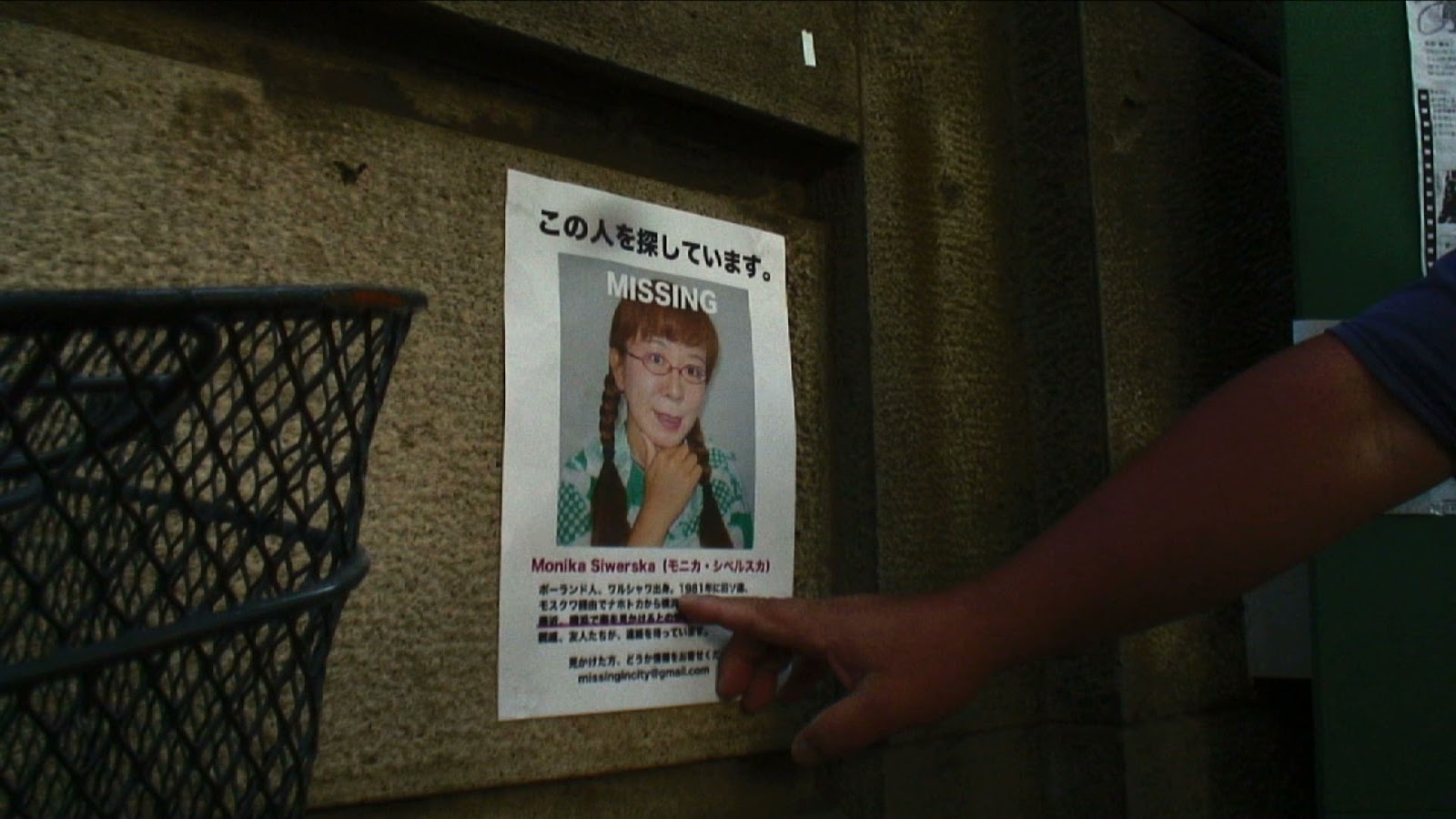
An upcoming Etiuda&Anima Film Festival screening of “A missing self” made me revisit this project. I've realized that it suddenly acquired a new and disquieting dimension:

Its seemingly light and playful action took place just a few years ago: a Japanese performer, who wished to be anonymous, sought her “Polish self” by placing around Tokyo “a missing person” posters with her face. I decided to follow with the camera because I found it intriguing pondering of the limits of our personal borders and identities.

Now, in 2015 yearning for creativity and exploration, for self exploration clashes with fear and aggression. The EU immigrant /fundamentalist/nationalist crisis pressures us to retract into our cultures, to strengthen our born identities, to seek power by separating ourselves from others.

Are we going to allow madmen to define ourselves by limitation, scarcity and separation? Are we going to take power from coiling in or from expanding? Is our missing self within or outside? The very worst would be to arrive at the conclusion that nothing is missing.  It would be the worst because hubris is always severely punished.  

So although “A missing self” is only a rough sketch I am glad I did it and hope to further explore its theme in a larger form.

3/27/2014

A Lucky Boy

A Lucky Boy 
(Chłopiec, któremy się poszczęściło)

The short version:

please go to the Krakow Film Festival Trailers Competition page and vote.  The trailer with the most votes will be included in the Festival. I added the trailer for "A Lucky Boy" on March 26th.   The votes can be cast till April 10th.  

The longer version:

What to do with the harrowing historical past?  We can't forget it, yet we have to put it aside so it does not paralyze us.  The hero of this story is compelled to remember, but he also wants to forget in order to succeed in life.   The tension between the horror of the past and the need to move on is what drives this story forward. 

The story is about Stanley Opalka (82),  the author of "Escape from Russia", the memoir which chronicles his 1940 deportation from Eastern Poland to a Siberian gulag, then the ordeal of getting out of Russia.   Stan is consumed by the mission not to let the Siberian suffering of millions of Poles and other nationalities to be forgotten.

I met Stan two years ago and was intrigued by charisma, cheerful personality and the psychological price he has to pay to recall the horrors of the past.  The documentary tries to capture his division between remembering and forgetting.

"A Lucky Boy" in itself is a trailer of sort for a feature film based on "Escape from Russia".  The feature will continue my exploration of "tragic memory."

11/09/2013

Exhibitionism or hiding in a doc

A poster announcing "Stories We Tell" 
with the discussion afterwards. 

Yesterday at the University of Social Sciences and Humanities (in Warsaw) where I teach filmmaking there was a panel/audience discussion about "Stories We Tell".  I was of the opinion that the director did everything she could to lessen the emotional impact of the story.   In my mind, she did that in order to claim the subject, to project her, purposely unspecified, approach, and in doing so not to go deeper into the story.  I claimed that because Sarah Polley is a fantastic and very competent director (I am enchanted by her techniques in "Take This Waltz") and so I assumed that she was in total command of her emotionally lukewarm narrative choices in "Stories We Tell."

During the discussion questions were raised about her exhibitionism, which to me again, was just clever hiding of something she did not want to explore.  

10/25/2013

Documentary craft

Never forget to lie, 
directed by Marian Marzynski

Marzynski is in great form.  It is a pleasure to see him conducing Q&A after the screening of his latest at the Museum of the History of Polish Jews n Warsaw.  At 76 Marz is energetic, sharp and focused.  His way of handling unfocused questions is kind yet decisive.  A total command of the audience.   Quite inspirational.  

A few things jump out when he discusses making documentary films.  His method of opening  people up is to explain to them the limitations of his interest in what they are about to disclose on camera.  When recalling an event they are asked to focus on the very moment of that event and not to bring into their relation any extra knowledge of the people or things that belong to the event. Otherwise “a chase of thoughts” ruins the power of a testimonial.   

Paraphrasing, it is asking them to be as they were when the event was happening.  To forget judgment, comments, information or any knowledge acquired afterwards.  Just to feel.  Feel the past as it is now.  

He also stresses the importance of casting in making a documentary.  Casting meaning selecting the right people who would successfully help to carry the story forward.  An important element in "casting" is of course the ability to establish rapport.  In “Never forget to lie” Marz does it by presenting himself to his “actors” not as a director but a fellow Holocaust survivor.   

When asked about the interplay of narration and images he emphasizes that the images always come first.  A narration only provides that which is not possible to communicate through the images. 

7/10/2013

Directing philosophy


Pawel Kuczynski and Richard Shusterman 
on the set of "The Pragmatist."  
Photography by Piotr Rejmer

Below is the press release for an upcoming premiere screening of my new project.  The screening will take place in Krakow at the Contemporary Art Gallery Bunkier Sztuki on July 25th at 5 PM. 

Delos Films presents:

“Philosophical Encounters with Richard Shusterman”

This three-part video series paints an intellectual portrait of a noted philosopher and founder of the interdisciplinary field of somaesthetics, a project concerned with body consciousness, perception, and aesthetic stylization.  The video material is based on conversations recorded at and around Florida Atlantic University, Boca Raton, Shusterman’s current academic home.  Additional scenes present his international lectures and workshops with an emphasis on three recent visits to Poland.  

This video series is intended as an educational tool but it is also a preparatory work for a more personal documentary - “The Pragmatist,” currently in the works.

The Krakow screening will consist of the first two parts in the series:  “The Role of a Philosopher” (27 min.) and “Making a Difference” (30 min.)

Dr. Shusterman will be present at the screening and available for a Q&A. 

The series and the upcoming documentary are directed by Pawel Kuczynski, a Polish-American filmmaker whose recent productions focus on philosophy and art.  He will also be at the screening. 

Richard Shusterman’s web site: http://www.fau.edu/humanitieschair
Pawel Kuczynski’s web site: www.directing.com

4/07/2013

SIEMEK - Truth on screen

Prof. Jean Pierre Lasota-Hirszowicz
in a documentary about Marek Siemek
“The View from a Cathedral”

According to Marek Siemek, prof. Jean-Pierre Lasota-Hirszowicz (an astrophysicist specializing in black holes) was not only his best high school friend but also was intimately connected with Siemek choosing philosophy over physics.

You will have to wait till the film comes out to hear how prof. Lasota remembers “the Siemek’s choice”. Within the context of the narrative it will be revealing and quite shocking.

For now however I want to share a snippet from the shoot. It has to do with a remark made by the Professor when I suggested he enters a classroom with the camera ready to catch his natural reaction.

“ok, but it always seemed to me
that a natural way (“naturalność”)
does not come out well (on the screen),
that everything has to be set up first.”

This is an astonishing observation (at least for a "fly on the wall" filmmaker focused on chasing and catching happy accidents and in this way getting unfiltered “truth” of the moment).

I suspect that the people who deal with the Universe and the Way Things Work must know something that we “the civilians” don’t not only about the dimensions above us by also about life itself.  That the bigger and more grand perspective somehow sharpens their perception and understanding of not only the cosmos but also of the life on Earth. This is one of the reasons why the remark stopped me in my tracks.  (The Professor rejects my way of seeing his profession as needless romanticizing of his trade.  Of course he is right.)

Still, the offhand observation brought me back to muse over the old documentary dilemma of “the natural” versus “the prepared way”.     I am leaning to conclude that quite possibly the difference between preparations versus catching the stuff as it happens lies in the self understanding of those who appear in front of the camera. Clearly some need to be prepared more to come out naturally, while others are better when caught in the act.

Perhaps those who have issues with themselves, who are existentially unsure, have to be “caught in the act of being” without realizing it. Once they are made aware of the camera they start presenting their take of themselves, they try acting and since they don’t know who they are they instantaneously flex their “psychic” muscle trying to prove something. A disaster usually follows.

Those who are secure in themselves, who down deep know their boundaries, their self and their worth are usually game for whatever happens and come out naturally. Preparations and rehearsals don’t freeze them because they know who they are and remain themselves no matter what.


9/28/2012

Step aside


Andrej Tarkovsky (?, I am pretty certain it is him) writes in one of his books: “You have to be a servant of the work of art not a master of it”.  
And his long time editor Michal Leszczylowski says somewhere (I do not remember where)  “in bad movies decisions how to cut are made by either director or editor.  in good movies these decisions are made by the material.” (quoting from memory)

In short, humbleness.  

Perhaps this dynamic can also work in a simple and modest documentary which I am currently producing.  

I took upon myself to tell the story of a certain philosopher who is no longer around.  

The project is tentatively called "The Department of Historical Necessity". 

I just returned from another material collecting trip and discovered there that the hero of my story takes over in a very literal way: he makes me set up shots according to his (specific) physical ways of interacting with the world.  I just looked at these shots and they look eerily real.  

Where will it lead me if I allow it to take over?

8/25/2012

Documentary and philosophy (3 of 3)


Switching to a more specific, personal testimony: the easiest way out of the problem how to show an abstract thought on the screen seems to be to equate a thought with a person and profile that person.  I’ve done my share of those documentaries and noticed that they are most effective when their follow their heros’ unique emotions and sensitivities.  For example when working on a Zygmunt Bauman documentary ("Lawnswood Gardens") I kept asking myself "how would Bauman direct" - not to assume I would be able to approach the world the way he does (I would not) but to keep myself in check when facing the task of presenting such a person on screen.  The documentary cinema clearly loves emotions and sensitivities while approaches the abstract with hesitation.  

Aside from identifying and mining the hero’s emotions, also a “negation of the abstract” seems to work well when trying to bring philosophy to screen.  In “Philosopher’s Paradise”, a narrator does not understand an abstract idea of the hero of the film.  Constructing a watchable screen tale is helped also by the fact that the narrator is the son of the misunderstood philosopher.   Because of that, there is a constant and personal tension.  In my fictitious 30 min. short “Phenomenology of truth”, a made up philosophical theory (“the truth is only on the surface”) championed by the film’s main character is constantly challenged through opposing its message staging, framing and plot turns.  I am mindful however that this “negation” maneuver however, while working in this fictitious area, could for ethical reasons be unacceptable in a documentary.  

I am currently working on a yet another “philosophical” documentary titled “The Department of Historical Necessity”.  It will be a story of Marek Siemek, the profound, brilliant and esteemed professor of the Warsaw, Bonn, Jena and other universities.  (“there are about 20 people on the planet that can think and Marek was one of them” someone says).  Yet, in what may be a cop out in terms of the subject discussed in this entry, I have to admit that the “juice” and the drive of the film will come mostly from Siemek's tragic life turns, his amazing charisma and personality as well as from his inner demons.  I will of course make an effort to communicate in a clear way his intellectual and philosophical dramas but the overall story will have to be constructed with the classical beginning, middle and end, with the good and the bad guys, with the plot turning and (hopefully) surprising the viewer.  

So, aside from choosing interesting or dramatic people who express abstract thoughts, aside from applying various dramatic devices to make stories about the abstract issues fit formulas of the contemporary storytelling what else can be done to further bridge the disciplines of philosophy and documentary filmmaking?

My tentative list of certain film grammatical figures and structural approaches that might help in a less apodictic and primitive screen storytelling that seems to be the norm of today include:
  • to allow each (abstract) beat to sufficiently reverberate so that a viewer can absorb it. 
  • to seek rather than to preach. 
  • to pose a finding in a form of a question rather than the answer, since each statement pretending to be the full explanation of a given problem invites by default its opposition and by doing so undermines the effort to “seek together”. 
  • to try not to follow the obvious in exploring a problem.  (Aren’t the documentarians charged with the task of showing something that would normally be hidden to a casual observer?)
  • to use sound as a driving force for images, rather than the other way around (at present the dimension of sound seems quite mysterious and allowing for forming fresh and unexpected associations)
  • to limit spoken abstractions to minimum.
  • to seek ways to equate abstract terms or emotional states or intellectual attitudes with spaces.  Once that’s done a space can become a representation of an idea (an example from a feature film world would be “dream” and “consciousness” presented in “The Eternal Sunshine of the Spotless Mind”.  (Yes, despite the main theme of this post, I think the most promising inroads into expanding the film grammar come nowadays from the independent feature film area.)
When all is said and done clearly the bottom line in coming up with (intellectually) satisfying documentary film storytelling is the sensitivity and maturity of a storyteller (not age related) and for that even more than in the subject of “documentary and philosophy” there are not fixed findings, lists to follow or insights to give.  

That’s why I was so late. 

(3 of 3)

8/21/2012

Documentary and philosophy (2 of 3)


Usually good philosophical texts exude passion, emotion and underlying dramatic structure of intellectual kind.  Their structure comes from their thesis, assumptions, inner conflicts and the way points are developed.  Therefore one could break down a philosophical discourse into a dramatic grid not unlike the Hollywood three (or four or seven or whatever) act structure.  Once that is done, it would be possible to seek proper emotional or dramatic representations of the elements of this structure and present them visually.   (Various attempts to revolutionize the aristotelian/hollywood structure are still returning to the basis)

A single “philosophical thought” is never a hundred percent purely abstract.   It is so because, language, even when dealing with abstract terms (such as truth, justice, beauty, knowledge, meaning etc), does not leave them in our minds totally abstract.  Each of the above terms (and any other philosophical word) triggers some sort of mental image.  For example when we say or hear the word “truth” it never stays in our minds removed from reality.   It is always a specific truth.  It is always “the truth”.  We may not fully realize the specificity of our abstract thinking but it is always there, obvious or hidden yet always present.  Therefore it is safe to assume that underneath an abstract term lies always a specific image.  Respectively no specific image is devoid of abstract meaning: whatever we see triggers associations in our mind.  
The above point gives hope to the thesis that there is a common ground between visual and abstract: perhaps a translation of the world into a language and translation of the world into visuals both come from the same base. This primal ground would be a pre-language and pre-visual unity. It could become a well from which one could dig out primal “communicative elements”. “The communicative elements” would be the images and sounds laced with pre-cognitive meanings joined by their common origins. They would be the alphabet for a true philosophizing cinema. Would it push the field into a new form? Hopefully, yes.

(2 of 3)

8/20/2012

Documentary and philosophy (1 of 3)


I am late. 

Months time ago a colleague of mine, an accomplished documentary film director asked me to write something about the connections between documentary film and philosophy.   In our talk the “philosophy” part came almost as an afterthought, an addition to the main theme which was documentary filmmaking as a genre.  Before our meeting the colleague had attended a screening of “Lawnswood Gardens” and saw a few previous titles of mine, also dealing with philosophy, hence I guess the phrasing of his request.  

In my mind my screen interest in philosophy is really only a skin deep.  It just so happened that during the last decade as a film documentarian I have been hanging out with various academic crowds of “lovers of wisdom”.  It influenced many of my productions dated from the first decade of the 21 century.  Some deal with heavy subjects of “truth”, “universalism” or post-modernity.  Yet, they were always the subjects of filmmaking rather than attempts to philosophize with camera.

Therefore what follows are just loose remarks coming from a practitioner rather than a theoretician. 

It seemed and still seems to me that an exploration of documentary film technologies and its subjects would yield similar conclusion regardless if the discussion was triggered by documenting thinking, object production or character representation.   That is assuming that as my spiritual and professional guru (I’ve never met him) Krzysztof Kieslowski stated documentary filmmaking tends to follow a thought as opposed to feature filmmaking that usually follows a plot. 

Yet, if a documentary by its nature is closer to the process of thinking rather than to storytelling than indeed perhaps zeroing in on meeting between philosophy and film could be interesting for exploring theory of a film-making craft. The distinction between theoretical thinking and following a story would however in itself require a closer examination.  Such examination would clearly exceed the preliminary and sketchy nature of these quickly jotted remarks.   For example the implied assumption that story presentation and its consumption is somehow simpler and inferior to “pure” thinking would need to be closely analyzed in terms of what is “story”, what is “thinking”, how they differ, how overlap and perhaps influence each other. 

Anyway,  

I was delaying my response, dragging my feet due to difficulty in voicing something that would not seem obvious, banal or too esoteric.   Finally the pressure to deliver has outweighed the hesitations.  I have decided to put forth a few intuitions accumulated during those long hours of exasperation when I racked my brains trying to give screen justice to abstract subjects.  They come as points to myself, indications of potential ways to proceed in practicing the craft rather than (God forbid) rules, which of course I don’t know.   So here we go:

(end of part 1 of 3 )

8/18/2012

Universal in Red with Black


"Red with Black" 
written/directed by Pawel Kuczynski

“A mystery conjured into a cow.  Reflections on the margins of “Red with Black”, a film by Pawel Kuczynski” is an essay by Aleksandra Drzał-Sierocka in “The contexts of art, the contexts of aesthetics” (in Polish, just published by Authors and Officyna”.)

The author is kind to my 2008 effort portraying painter/sculptor Henryk Musiałowicz.  The essay title refers to Musialowicz openness to nature: “this great artist is enchanted by a cow and does not hide it.  To him art is a road to self discovery and as such should be based on a watchful and courageous search (...)

The director does not respond to questions about the meaning, mystery and rebirth which are posted every now and then by Musialowicz.  Instead he leaves them hanging and allows to reverberate.  Clearly sometimes more power comes from stating the uncertainty than from solving it.  

All that composes the unusual climate of “Red with Black” which is a very intimate and reflective film.  Even though it presents a specific person, it attains a certain degree of universal dimension.” 

I am glad that the reviewer talks about "universal".  However never during the making of this project I consciously attempted such a response.  Rather, I was just trying to offer my purely emotional reaction to the Maestro and his art.  

The question arrises where does the "universal" come from: is it the result of a subject, a narrative approach (conscious or unconscious) or does it, to a large degree, result  from a viewer's sensitivities?  

More information about this project and links to a trailer: http://www.directing.com/red.html


1/18/2012

Pitfalls of personal docs.


Trying to keep with the self imposed restriction of not criticizing specific movies by other directors (OMG, is it difficult or what!), and after seeing a certain first person documentary, let me list a few dangers that await those of us who put themselves into their own movies:

1.
Showing your own face in extended shots and looking pensive doesn’t automatically translate into depth.

2.
A collection of interesting elements does not automatically turn into a subject. Since it is the connections between these elements that ultimately make or break the narrative we need to strive to join the elements rather than to just list them. Joining would be showing their connections or finding a common thread that on a certain level unifies them.

3.
Our personal divagations, if not properly presented, do not necessarily have to concern the audience. The border that separates a display of narcissism from universal is ladened with traps of ridicule, boredom and stupidity.

4.
Most of us are more boring, irritating, shallow or dumber than we think we are, therefore pointing the cameras at ourselves should be preceded by a hard look into the mirror. If there isn’t much reflecting back from the mirror but we still absolutely need to share our precious selves with the world let’s at least make it visually intriguing and try to push formal aspects of the storytelling.


10/24/2011

The Bauman’s Window


Before the screening of “Lawnswood Gardens”
organized by Polish Sociological Society
and Warsaw University Students Association


A panel discussion afterwards. Prof. Nina Kraśko - the moderator,
Paweł Kuczyński - director, Andrzej Chrzanowski - co-producer,
Piotr Rejmer - head of post-production.


“The film is brilliant. (...)

There is no such thing as a Bauman school.

However, there is a Bauman window”.

- Prof. Monika Kostera, Ph.D.


This comment refers to two elements of the film. The first comes from an informal talk where prof. Bauman’s says (in Polish):


“I don’t think I am going to leave behind something like the Bauman school for example, because in order to form a school of thought, you have to discover a method which distinguishes this school, and then any person who wants to do a Ph.D. has to prove that he can use this method adequately. This to me seems like schooling in conformism and in following a recipe, like unexperienced cooks who surround themselves with cookbooks and know (to add) 5 grams of that, 10 grams of that, here 5 minutes boiling, there 6 minutes etc. I’ve never created anything like that. What’s more, I think something like that would be against the sprit of the humanities.”


the second is a quote from “Modernity and the Holocaust”:


“...(the analysis) showed beyond reasonable doubt that the Holocaust was a window rather than a picture on the wall. What I saw through this window I did not find at all pleasing. The more depressing the view however, the more I was convinced that if one refused to look through the window it would be at one’s own peril.”


While filming I considered exploring views from various places where the Baumans lived and naming the film “The Bauman’s window”. Even though I abandoned this path something from that concept must have filtered through into the final version.

photos by Anna Polańczyk

8/30/2011

Documentary truth, part 2

"The Arbor" by Clio Barnard

This is an attempt to discuss the assumption that in a documentary the more unfiltered reality is, the closer to truth.

The previous post argued that in a documentary film a public, charismatic personality usually (either consciously or subconsciously) “performs” since being “on” constitutes the core of such a personality. Therefore one should not talk in such cases about “truth” understood as something that is revealed despite the filmmaking conditions. In short - I don’t see much of cinema verite in the documentary about Vaclav Havel.

The documentary truth in that group of films therefore is synonymous with “presenting oneself”, which assumes a certain amount of performing, where performing is not a negative term but the acknowledgment that in order to present something to the public that something has to be dressed up in a form (a bow to Witold Gombrowicz here.)

What about a form when a film deals with more private people or with events or trends that have no self-consciousness of their public dimension or simply do not have any trace of “performing”? I am inclined to say that the similar process could happen there as well.

“The Arbor” by Clio Barnard seems to be a case in which the more reworked (enveloped in a form) reality is the closer it gets to its core. (The core would stand for reaching a basic pattern or emotion or the dramatic origination of the story being told). For example an amazing energy is evoked when two sisters (portrayed by actors) recall their childhood trauma as this very trauma plays behind them in the room. This obvious break with reality only adds up to the intensity of the message.

Some, writing about techniques in “The Arbor” bring up Bertolt Brecht and his “distancing effect.” Perhaps, however many “quotation marks” narrative maneuvers in the film rather than alienating me from the events in order to force my thinking about them, have the opposite effect. By bringing up various “look this is not happening for real” tactics (like staging interior scenes from a play in the square while the neighbors watch or famous lip-synching) the film actually manages to dispense the ever present suspicion with the medium itself. Once the thorn (as a film form inherently fake and therefore untrue to reality) is named and brought up into the open, I the viewer, can relax and am able to travel straight where the storyteller wants me to be.

Therefore as performing of a charismatic individual is a must for his truth to emerge so the narrative that “performs” is often needed to reach the essence of a story.

7/23/2011

Documentary truth, part 1

On the set of "Citizen Havel".

What is truth in a documentary? What does it take to accurately portray a person on the screen? Does the term “accurately” relate to the way a person sees himself, the way others see him, or both? Are we who we think we are, or who we are in the eyes of others?

“Citizen Havel” by Pavel Koutecky, Miroslav Janek provides some food for thought on the subjects.

Some say this film is a “fly on the wall” documentary, or the ultimate “cinema-verite” of political films. To me it is more of a showman’s piece where the hero is most of the time “on” and fully controlling the message.

Despite statements from the filmmakers that Havel could “tune out” the camera there is always a clear indication that there is something between his very own self and the way he present himself to the public/camera. Yet even though this obvious barrier exists as a thin film over the screen we get the sense of Havel’s earnestness and his noble nature. It happens largely I think because we sense his efforts to be right.

Vaclav Havel is all about making an effort to be better, “to keep vertical” (as Kieslowski used to say, according to his friends), to improve the world around by leading, providing an example. That can’t be done without self examining and self consciousness. In this respect Havel by his very nature and his calling uses the presence of the film crew to telegraph his essence. Some say he forgets the camera, I would say he plays it as a good director or a stage play writer designing the story. His theatrical sensitivity should not be a surprise, he is a dramatist and probably,
more than many of us would be capable of, sees himself as a character in a life's play. Luckily, Havel is congruent in his message and in the way he is. That’s why, the more the director gives him screen time, the more president Havel reveals his true self - a warm, genuinely carrying guy with an surprising sense of theatrics.

Overall this documentary film is a creative effort both on Havel’s and the director’s part to present a certain class, an attitude which Havel employs in his life and makes an effort to articulate and strengthen via his public appearances, to which the film clearly belongs. There is a noticeable effort on his part to be “right” - in things small and big. He wants to be always prepared because he knows that everything he does sends a message. We “civilians” could only learn from him.

There are two scenes in the film where the camera retracts mostly to high angles and watches cars from above: during the arrival of president Clinton and at the funeral ceremony of president’s Havel wife - Olga. Both times - with different moods of course - the filmmaking eye catches the essence of events in a very cinematic way mostly via the mechanical movements of soulless machines, yet the spirit of each occurrence is
precisely telegraphed.

I’ve briefly met mr. Havel during a half hour interview for “Lawnswood Gardens”. He was exactly like the person in the documentary: thoughtful, sensitive, precise, concerned, slightly shy yet with power inside. It was a professional situation which at the same time spoke plenty about the private man. I may soon post on my youtube channel another “Lawnswood Gardens“ making of with a clip from that meeting.


7/02/2011

Lawnswood Gardens

"Lawnswood Gardens"
directed by Pawel Kuczynski
written by Pawel and prof. Anna Zeidler-Janiszewska

Last night we had a premiere screening of “Lawnswood Gardens” - a documentary portrait of professor Zygmunt Bauman. The hero himself attended, which as normal in case of his public appearances, attracted a crowd eager to meet him. We felt bad that the theater management had to turn people away due to the safety regulations.

Earlier in the day "Gazeta Wyborcza", a leading Polish newspaper, run an announcement calling the film “a comprehensive and insightful portrait of an eminent scholar, who grants the camera an unusually close access.”

Prior, culture.pl, the official site of the cultural program of the polish EU presidency has published the following write up:

"Lawnswood Gardens" is a 53-minute film portrait of Bauman, who serves as one of the main representatives of Polish intellectual thought. The core of the film is based on Anna Zeidler-Janiszewska's brief visit to the Professor's home at Lawnswood Gardens in Leeds in the spring of 2010. The film includes archive materials and other interviews, exploring the links between Bauman's "Modernity and the Holocaust" and "Winter in the Morning", a diary from the Warsaw Ghetto written by the Professor's wife Janina Bauman, who passed away in December 2009.

The film also includes a conversation with artist Mirosław Bałka about his "How it is" exhibition at the Tate Modern and the Professor's response to Bałka's work, providing a sociologist's perspective on art.

The film also features the Professor's friends from Leeds: Anthony Bryant and Griselda Pollock, as well as Aleksandra Jasińska-Kania, Nina Kraśko, Jerzy Wiatr and Vaclav Havel. Bauman's daughter, painter Lydia Bauman, served as the artistic consultant on the film.

The film was realized thanks to the support of the Adam Mickiewicz Institute, the National Centre for Culture and ZAiKS.

The full text of the write up is linked below (one correction in the director’s bio: my philosophy study lasted only one year)