8/21/2026

“Enjoy the Ride and Eat Bananas”


Illustration created with AI. Naturally.

A few thoughts about The Economist interview with Elon Musk.

Musk states that there is about a 20% chance that AI will wipe out humanity. Yet he proceeds with its active development. He does it “philosophically,” as if adding this word somehow lessened the gravity of the statement. As if “philosophically” absolved him from the horror of the assumed consequences.

Not only does he seem resigned to this rather high statistical possibility of calamity—or collective suicide—he actually seems to embrace it. With a smirk.

He says it, Zanny Minton Beddoes, the interviewer, hears it, we watch or read it, and... not much happens. What does that say about him, her, us? OK, she needs to keep the interview going. I understand that. A little bit.

But maybe that’s actually the most disturbing part. A man who is actively developing AI says, in effect, that there is a one-in-five chance this technology could destroy humanity—and the interview simply continues. He says it. She hears it. We hear it. And we move on to the next question. Somehow a possibility that should stop the conversation becomes just another talking point in a prestigious business interview. When did the possibility of human extinction become something we could absorb so casually?

Another scary thing about the interview is that he seems not to be saying what’s really on his mind. I just can’t buy that a guy with such a high IQ, a brilliant inventor and businessman, actually believes some of the stuff that comes out of his mouth.

So why does he say what he says? Why does he publicly state things that seem so illogical? One probably can’t build a space rocket with such a lack of clarity about the consequences of one’s actions. So either I am missing something in his reasoning, or he is withholding something about his real agenda.

What is that agenda? What is the purpose of taking the time to talk to The Economist? Is it simply to keep investors happy by advertising the product? Or is there something else?

Is it just basking in his own power? Is he auditioning? If so, for whom? Is he advertising? If so, what exactly is he selling?

Musk suggests that since we can’t do much to contain the explosive rate of AI development, we should “enjoy the ride.” And since the gap between us and AI will become enormous, we should do what monkeys do in our presence: just “eat the bananas” when benevolent AI brings us universal high income—meaning a shitload of money for everyone without anyone having to work.

“Enjoy the ride.”

“Eat the bananas.”

But suppose we take his 20% seriously. Suppose he genuinely believes there is a one-in-five chance that the technology he is helping to develop could wipe us out. Then the obvious question is: what level of risk would make him stop? Twenty-five percent? Fifty percent? Ninety percent?

And if there is no percentage high enough to make him stop, then what exactly does the 20% mean? Is it a warning? A calculation? A disclaimer? Or simply another dramatic number thrown into the conversation while the development continues anyway?

That’s the guy who publicly and defiantly displayed what looked very much like a Nazi salute.

8/04/2025

An appalling nightmare...

Browsing through my notes I found a quote from Terence McKenna. It chimes with my recent interest in a story about people obsessed with aesthetics.


5/07/2025

Full service in both places.


a funeral parlor and a hair salon. 

3/26/2025

Writing on the wall


I saw this on a Warsaw Old Town wall about a month ago.  Seems appropriate in time when we are tormented by the ego driven dramas (and farces) from the highest places on the planet.  Not to mention the same happening in our closer circles (I'm just guessing...)


9/14/2024

Coppola and real life

Just finished reading a wonderful "The Path to Paradise. A Francis Ford Coppola Story" by Sam Wasson. It's a fantastic book.  

At the end of it the author acknowledges the openness and support he got from Coppola.  They must have hit it off from the start, I guess.  The character of FFC that emerges from the book is fascinating: always curious, always passionate, taking risks, sensitive and mad at times.  

Among many intriguing isights there is one that I've been thinking about for the last few days. It is an account of what FCC said to Sam Wasson about the creating process.   It was the thought that a director controls the elements of his creation the same way the painter controls the brushstrokes on the canvas or a writer controls the words on the page.  In the case of film the director he controls "the real life".  Another words to produce a strong, significant film whatever happens in front of the camera or later on the screen has to be a part of real life.  He spoke about it while discussing "One from The Heart" but I thought about "Apocalypse Now" which is so real, so personal, so dramatic that it fits the above deception beautifully.  

It is also an admonishment to those who try to put things in front of camera that are not filtered through the "real life" urgency.  

9/29/2023

Connections

I finally saw "Human Nature" the first collaboration between Charlie Kaufman and Michael Gondry.  So wonderful that even though the reception of that film was generally bad they continued into "The Eternal Spotless of of the Spotless Mind."

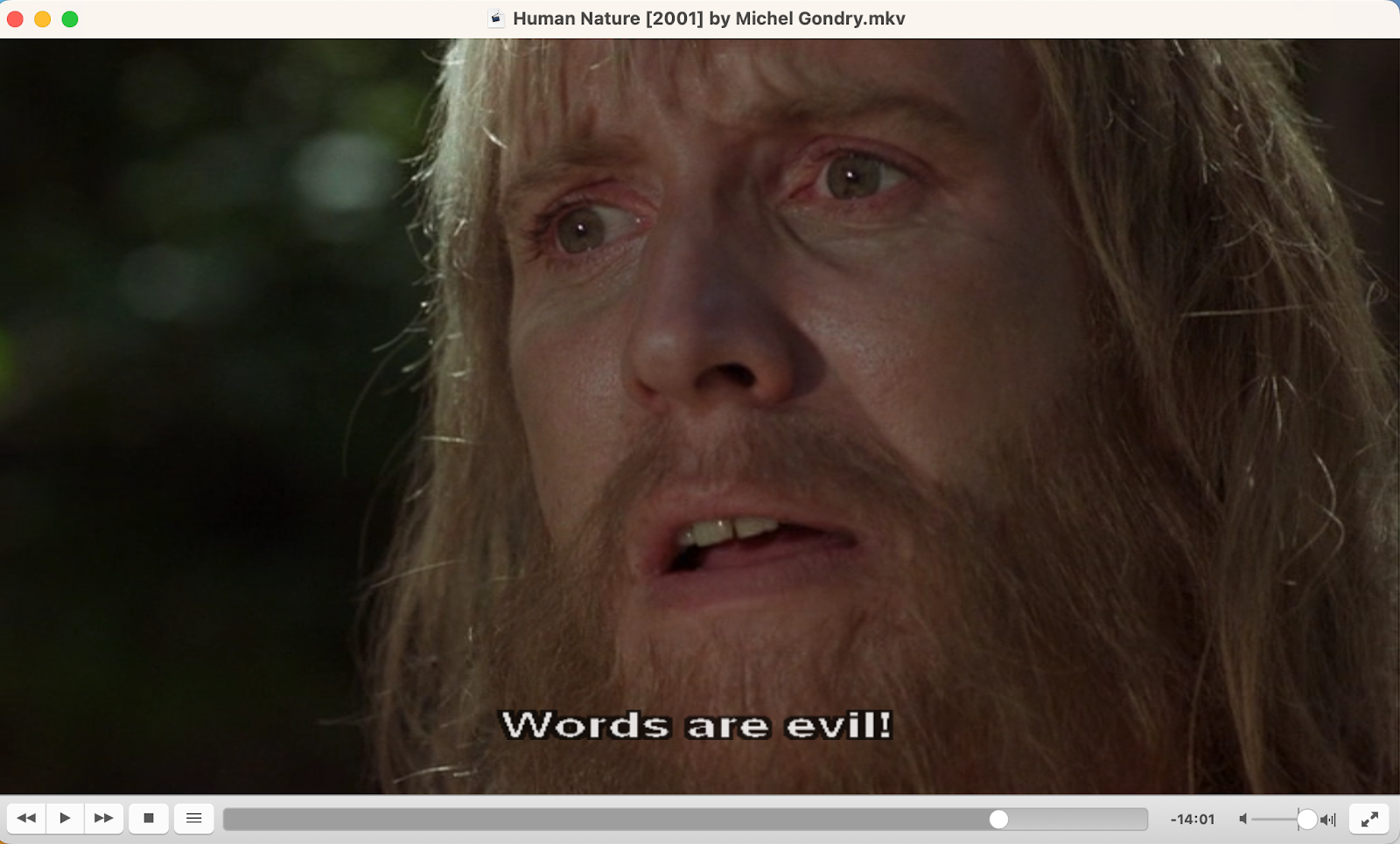
In the "Human Nature" there is one wonderful moment (among many) where the ape "goes ape" about the way we relate to the world.  (Wittgenstein anyone?)


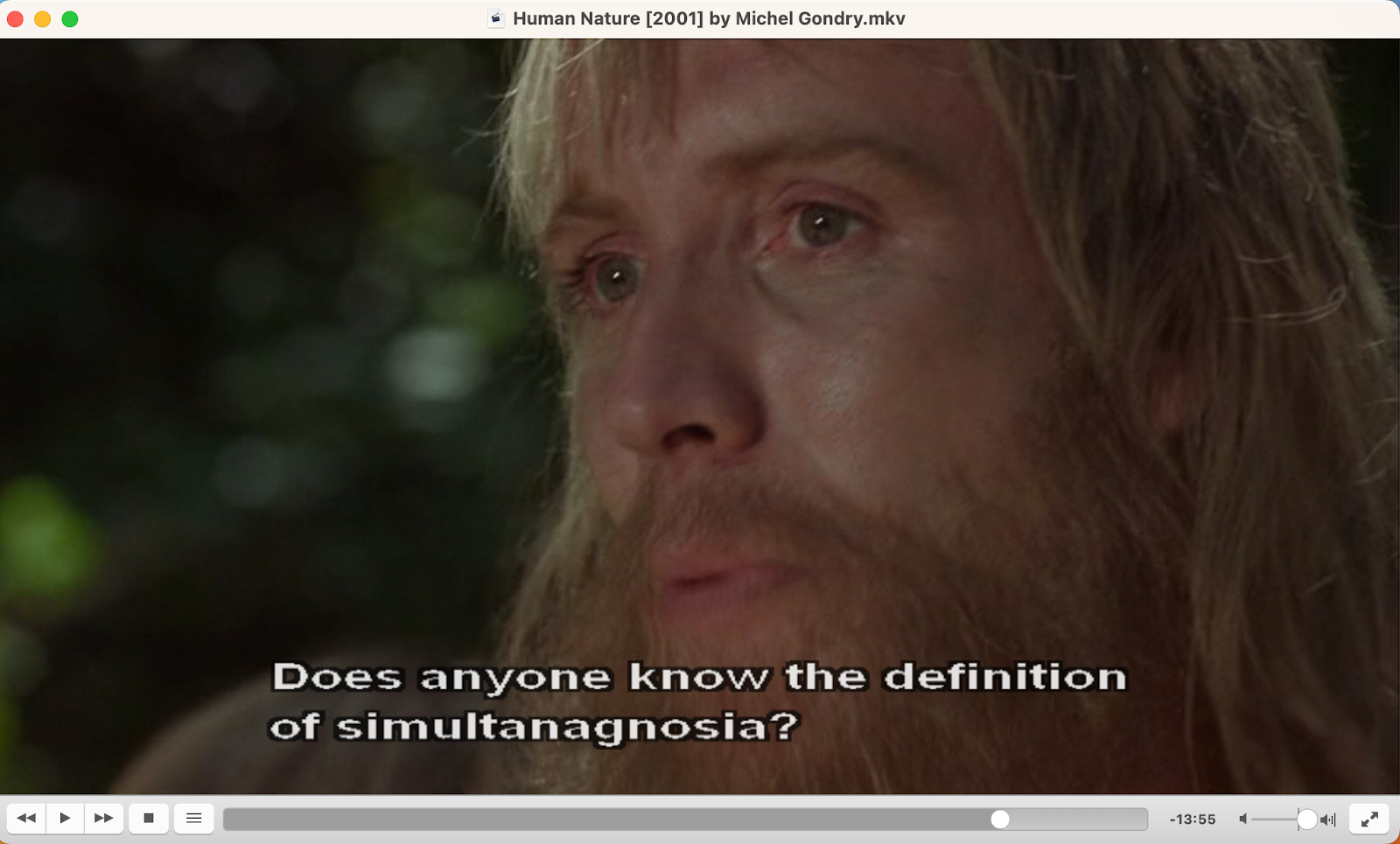
Then the ape asks about the meaning of simultanagnosia". 


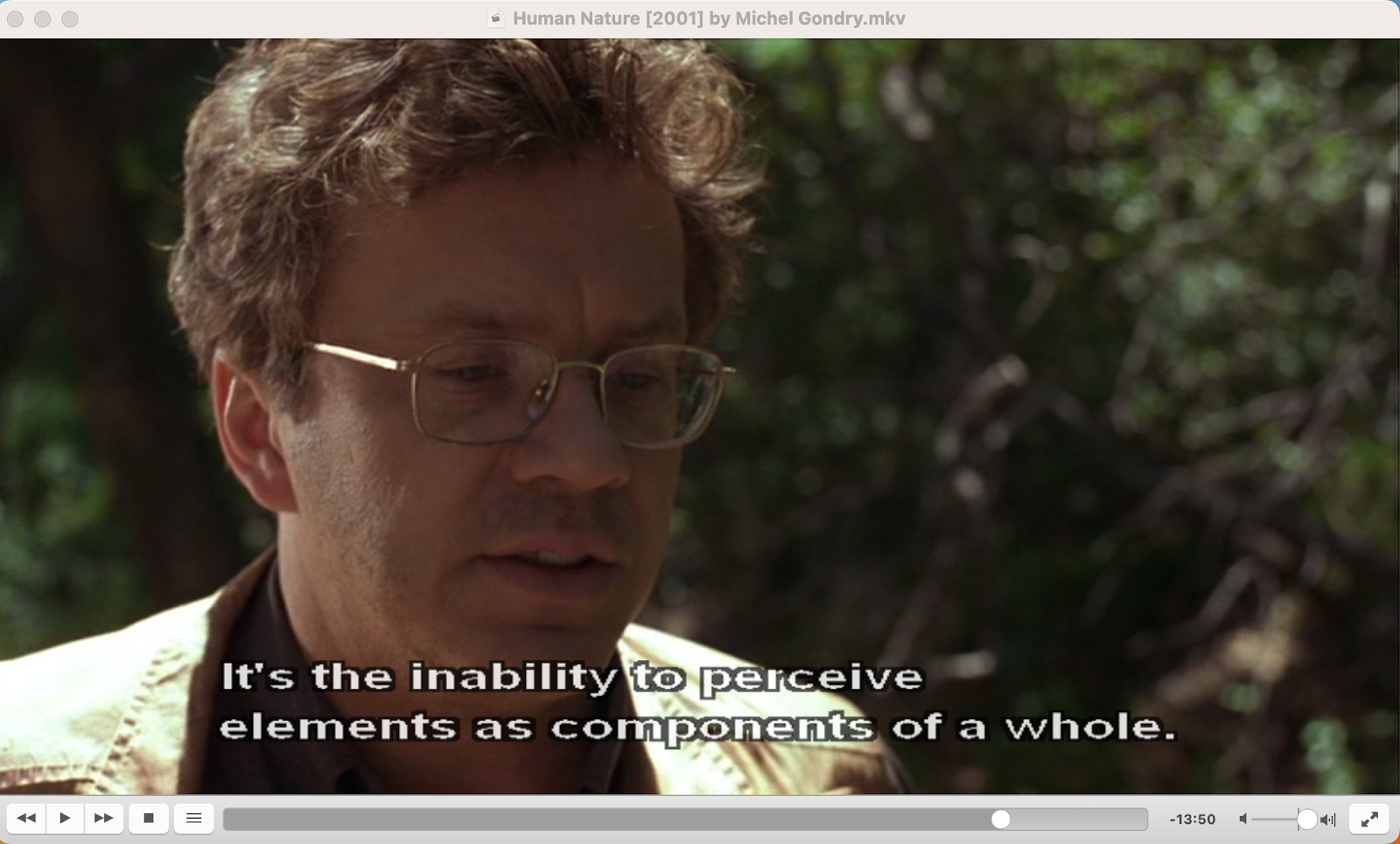
Natan, the brainy characters responds: 


Elegantly said. Google explains it in the following way:

“Simultanagnosia is the inability to perceive more than one object at a time. Patients are capable of identifying individual elements of a complex scene but have great difficulty in understanding what is occurring overall within the scene (i.e., “cannot see the forest for the trees”)”

This idea chimes with my recent state of mind: It so happens that I'm re-reading now “The Books of Jacob”, by Olga Tokarczuk. It contains the following passage:

“Ascher Rubin considers most of the people stupid and it’s that stupidity that brings sadness to the world. It’s neither a sin nor a virtue with which a man is born, but simply a bad way of seeing the world, erroneous understanding of what eyes see. As a result people see each thing separately, each disconnected from the rest. True wisdom is an art of connecting everything with everything, because then the true essence emerges.” (translation PK)

The question of the narrative technique is how to implement this approach in storytelling. Adding elements to emphasise the connection? Remove elements to penetrate the connections more within a singular? Mix the two approaches? Use other tools to seek unity of everything?

8/29/2023

Polanski and his Magic

When I wasn’t here I have been hanging out at the YouTube channel “Thinking Camera”.  The most recent entry there is about one of my favourites: “Chinatown”. 


Let me add a few things to the content there:  


I dared a risky thesis on a supposedly rhythmical arrangement of geometric values in the flow of composition there.  I haven’t checked/examined its validity yet but since then came across a wonderful podcast/conversation between Robert Town and David Fincher about the film.  There they discuss the rhythmical occurrences of the double elements in the film: glasses, car tail lights, eyes (you got a spot in your eye), cigarettes, even nostrils etc.  They say that Polanski probably wasn’t conscious of those rhythms, yet they are there.   So it’s possible that my statement wasn’t entirely bs.  If anyone out there is game - checking the rhythms of compositions in Chinatown is a project to jump start. We could do it together.


My short remark about the Gittes character is shallow and one sided.  In their conversation Fincher and Town examine Gittes with his ambitions, limitations and values.  What emerges is a full scope character.  Needless to say I regret a fast wording to describe a complex being.


The origin of the magic of the film is an interesting issue. Polanski says he wasn’t really thinking while making the film that it was something special.  It was just a job, he says.  On the other side of the spectrum is Robert Evans - the force behind the production - who says that magic happens when you’re a bit irreverent, almost as if a certain modicum of irreverence is a must for magic to happen.  


Unrelated to Chinatown: Polanski’s conversation with Charlie Rose is fabulous. You can see there how a person with a massive intelligence reacts with respect to a journalist whom he considers solid and worthy to be treated seriously.  I suspect that some of the questions that Rose asks if presented by somebody else would trigger quite different responses from the director.