8/27/2015

Poetry is hard

A Pigeon Sat on a Branch Reflecting on Existence
 by Roy Andersson

I feel bad.  Everyone says it’s a brilliant movie (and one of my favorite directors - Alejandro González Iñárritu is championing it in the States) and yet I am bored and annoyed with it. 

The film comes across as if the exquisite form of the narrative isn't really sticking to its content.  Except of one truly terrifying scene (a bizarre dreamlike killing slaves/art musing) most situations feel extended way beyond their thin premises.   The tableaus are beautifully staged and then not much happens. 

OK, OK I know I am supposed to be excited about the grotesque, the ugly and yet emphatic, the surreal,  about the stretched out dry wit, but c'mon: it’s 2015!  Haven’t we talked many, many times before about „how fucked up we are”, about the fact that "life is weird and we are pathetic and caught in self-inflicting dramas"?  Yes, we have. Yes, we have (that's a movie quote, I think:-)

I know, there are only 25 narrative situations and art is not about saying anything new but about saying it in a new way.  Fair enough:

So, are we indeed so jaded that have to be jolted by theatrical, repetitive tricks?  What would Bunuel say about this film?   Wouldn’t he laughed that it’s too forced, too staged, too much in love with its own aesthetic „illuminations”? 

I suspect the director has been drunk on the excitement coming from him chasing poetry, which as a creative process is indeed very tasty.  But in order to serve such a dish to others one should work harder.  (O boy, I can hear already your thinking - yeah, Pawel smart- ass, why don’t you than show us how to do it better.  I don’t know how, I am writing it as a consumer only.  I bow my head to the director’s technical abilities which are indeed awesome.  But so what that he stages and manipulate space beautifully if the substance of his talk is suspiciously thin - to me, that is.)

Then I searched for some Andersson’s interviews.  Came up with this quote about Bergman:

„He’s always battling with his relation to God. Sometimes I think it’s not very serious, it’s hypocrisy. He’s not really honest about his battle with God, its just good stuff for a movie!”


Really? That’s preposterous.  Maybe pushing the strained thin absurd musings about how pathetic we are is equally hypocritical since it could be also called „just good stuff for a move”.   

Clearly, poetry is hard.  Dry wit poetry is even harder. 

A coda: I really liked his previous installments of the Human Trilogy.  I thought that in „Songs from the Second Floor” and in „You, the Living” his scenes were right on.

8/12/2015

Shadows


at the Roman Vishniac photo exhibit 
Polin Museum, Warsaw

Watching one of the iconic images of the great Vishniac taken in Berlin in the late 20s of the previous century.  

The photography and its viewers are almost a hundred years apart. The shadows remain.   Does the original photo and its contemporary display above first trigger an aesthetic reflection or rather a moral and historical one?   

photo by Vanessa Gera

7/20/2015

two dialoques


- Dad, do you remember how old the universe is?

- 7 milliard years.

- Twice that. 13 milliard, 700 million.

- That much?

- Yes.

- Than it’s better to stay home.

- I agree.
 ----------------------


- Son?

- Yes, Dad?

- Do you realize how good it is that there is life?

- I do, Dad.

6/22/2015

When quality destroys

She’s Funny That Way, 
directed by Peter Bodanovich

It would be too easy to utter smart ass remarks about a movie that doesn’t work.  I try to stay away from such comments. However at times in a lame flick fascinating things happen.

I admit, I watched this movie while distracted. Had to take a few calls and return a few text messages so I was out of the cinema hall a few times. Every time I was back in front of the screen the movie felt weird. I though I just wasn’t focused enough since it was the Maestro Bogdanovich directing.

As the film progressed the excuses for my subjective “not getting it” were getting weaker and weaker, but I was telling myself “come on, this is just a light, screwball New York comedy, relax and enjoy. After all you are a big fan of mistaken identities plots and that is sort of that”.

Then at the end of the film came a few black and white shots from an old movie. It was supposed to justify and reveal the origin of a running gag.

From the first second of seeing this quote I felt awakened, energized and intrigued. The framing, the lighting the lenses, the composition, the intensity of the actors were right on. (In the Bogdanovich film a few actors were also great.)

The black and white quote was like an explosion of quality on screen. It produced a wave that went backward making it painfully clear that everything prior was lame. At home I researched the quote: it came from a flick by Earnst Lubitsch!

The only question is how could such a learned film scholar and a brilliant director in the past allowed for this self defeating blow proofing his lack of form. The “Squirrels to the nuts” (the earlier title of the film) would have been just a passable “shall we switch the channel, ah, let’s wait maybe it will get better” movie. Instead by the contrast with the quote it turned out into a disappointment that rubs its faults into its wounds.

Sometimes putting a truly great element into the work (quote or no quote) can seriously undermine it as a whole. Almost like a twisted “kill your darlings” application.

On many levels, it is a humbling and cautionary case.

6/17/2015

Karski

FDR in "Karski and the lords of humanity" 
by Slawomir Grunberg

This documentary is about a Polish WWII hero, Jan Karski, who after being sneaked into a ghetto and a concentration camp, personally informed Franklin Delano Roosevelt about Holocaust. On the screen, when talking to Karski, FDR is presented as a pompous, grandiose figure, who with the exception of a few empty words, didn’t do much to stop the catastrophe in Europe.

The idleness of FDR, and inertia of the allies, who did not want to bomb Germany specifically to stop or at least to lessen Holocaust haunted Karski to the end of his days. He was tormented by the self imposed guilt that somehow he failed to convince the Wester powers, the Lords of Humanity. Seeing Karski trying to deal with this burden is heartbreaking. It is so because he did more than his share in opposing evil, yet those informed by him didn’t act on this knowledge.

The film ends with Karski urging everybody not to be idle when witnessing or being told about bad things, no matter how small they are.

5/25/2015

The premiere


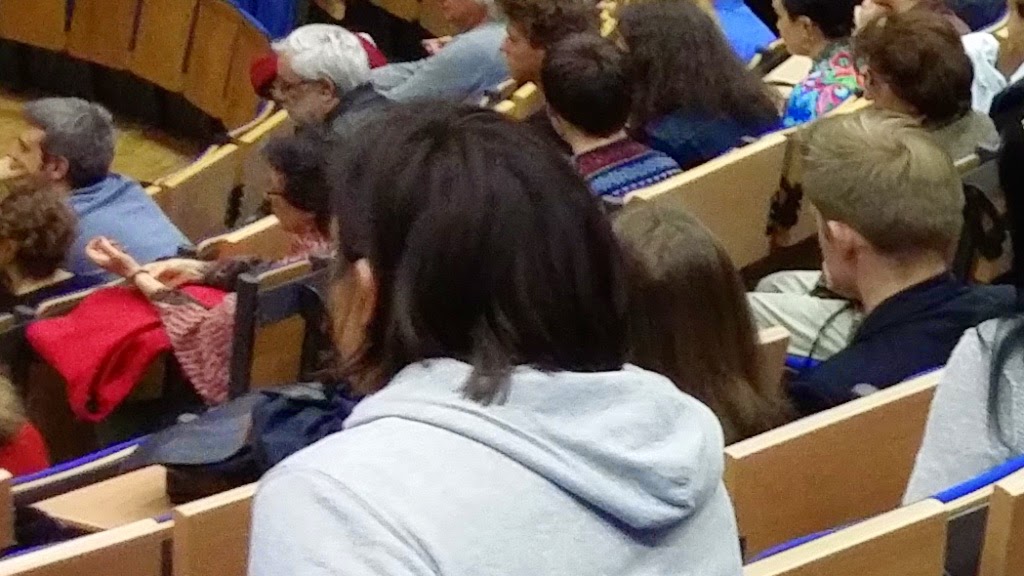
The premiere screening of "The View from a Cathedral".  

The event was opened by the Vice-President of Warsaw University, Prof. Alojzy Nowak, who said that during his frequent travels (he is responsible for the international cooperation) the most frequent question he hears is ...... "did you know prof. Siemek?" 

Hearing him and others talk about the hero of "The View..." made me realize how privileged I was to be able to work on this project. 

Thank you all for making it possible.